

Beech Leaf Disease
Beech Trees of New Hampshire, Massachusetts, & Maine seacoast are struggling. Here's why and how we can help.
Have you noticed that the Beech trees have been looking rather thin lately? Perhaps you have noticed that some of these Beech trees have leaves, but the leaves are distorted, puffy, and have a thick or dark appearance to part of the leaves. You’re right to be concerned if you see this. This odd appearance to the Beech leaf is caused by an invasive microscopic worm called a nematode and it is devouring our native beech tree forests.
To discuss Beech Leaf Disease we need to know we are correctly identifying a Beech Tree. Let’s begin here.
What is a Beech Tree? And It’s Beech Tree, not Beach Tree (those are Palm trees– which aren’t really trees, that is a subject for another day)

Beech Leaves (Shape & Color)
All leaves of beech trees are simple and alternately arranged along the branches. However, they come in a few different shapes. The most common shape is those found on our native American beech trees. These leaves are elliptical to oblong with sharp parallel veins and a toothed margin along the leaf edge. You can find them with a smooth edge and glossy texture like those on our European Beech, Copper Beech, and Weeping Beech Trees. Finally, you can find them with in a lobed form like that of the Cutleaf Beech and Fern-leaf Beech which usually looks almost feather-like in appearance.
You can find the Beech tree in many different colors. The traditional leaf color of the Beech tree is a glossy green color, but you also find beech trees with a deep red-purple color known as a copper beech tree, and the flamboyant tri color featuring purple, pink, white, and sometimes green.
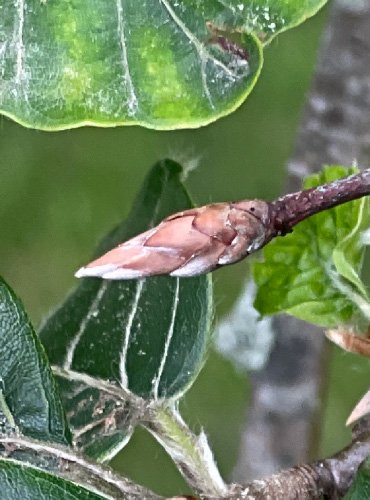
Buds
Aside from using the bark as my key identifier for my Beech tree Identification in the winter I also look at the buds. As an arborist, I am often tasked with identifying a really young tree that has not taken on its characteristic bark. It’s like looking at a baby bird without its feathers. The bud is my key to identifying the sapling. So, for Beech trees the key identifier is that the buds look like a long skinny tightly rolled Cuban cigar with a pointy end.
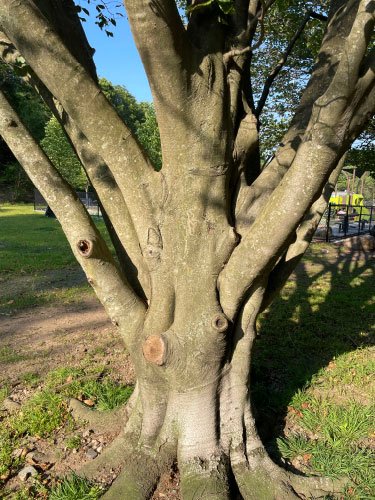
Bark, Trunk, & Shape
Beech trees are smooth barked trees with a light grey color, which almost have the look of elephant skin. In fact, many clients on the New Hampshire seacoast have shared stories about climbing in a Beech tree as kids, they called these giant trees, “elephant trees.” Perhaps you have a similar memory. Even the branching structure of the Beech can look like the trunk of an elephant. The beech tree’s branches extend far out and often dip low to the ground and root themselves. Beech trees can take many forms, they can be fastigiate (growing narrow and upright), they can have to large sprawling canopy (like the kind you see on college campuses and in front of historic libraries), they can also come in a weeping variety and provide a magical place for young children and adults to gather and build their creative imagination.
Now that you have determined what a Beech Tree looks like Let’s talk about what Beech Leaf Disease is and how it kills the tree
Beech Leaf Disease is caused by a microscopic nematode that overwinters in the buds of Beech Trees. These nematodes are host-specific, so there is no need to worry about other tree species. During winter, they feed within the buds. It is still largely unknown whether their feeding directly causes the distorted, curly, puffy, and often leathery leaves, or if they carry a vector responsible for these symptoms. However, it is known that eliminating the nematode can save Beech trees. As the disease progresses, leaves become increasingly distorted, and a premature drop can occur. This happens because the tree shed leaves that are unable to photosynthesize, rendering them useless. When leaves become too distorted to photosynthesize effectively, the tree will starve.
Older Beech trees have some resilience; they can use stored energy to produce a secondary flush of leaves if they are approximately 10 years old or older. These secondary leaves typically do not suffer from infection, as they develop from buds that did not harbor overwintering nematodes. Despite this capacity, the process is exhausting for the tree, akin to climbing Mount Lafayette without food—possible a few times, but unsustainable over the long term. Young saplings lack the energy reserves to survive without immediate protection of their leaves. Older trees have a greater chance of survival due to their larger energy stores.
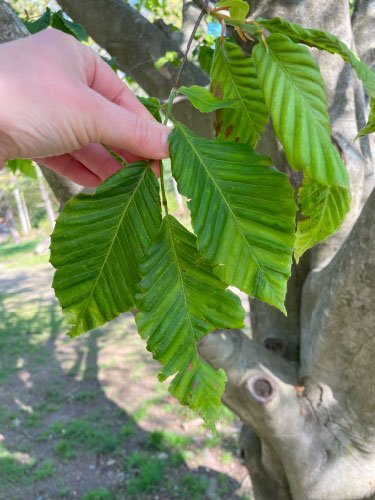
Beech Leaf Disease in Leaves
The leaves of infected Beech Trees exhibit distortion with thickened segments between the leaf veins. These segments may feel leathery, stiff, or dried out as the disease progresses. In advanced stages, the leaves may crinkle and drop prematurely in early spring, causing the tree to produce another flush of leaves to feed themselves.
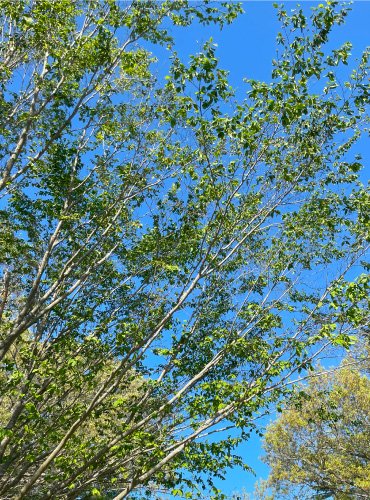
Canopy
While leaves are the primary indicator for diagnosing Beech Leaf Disease, it is also recommended to observe the density of the tree's canopy. A thick and full canopy typically indicates that there is little to no infection of Beech Leaf Disease. Conversely, a canopy that appears thin, sparse, or irregular suggests a high likelihood of Beech Leaf Disease infection, potentially accompanied by a secondary infection.

Secondary Infections
Let's discuss secondary infections. When a tree is stressed, such as by Beech Leaf Disease, it releases a stress hormone that attracts insects like the woolly beech aphid. Treating Beech Leaf Disease can reduce this stress and potentially eliminate the need to treat aphids. However, monitor the aphid population to ensure they remain below the treatment threshold. The photo above shows a very low population level of Woolly Beech Aphids (white fuzzy insects on the underside of the leaf.)
Now it is time for you to look for the disease and be proactive
If you have Beech Leaf Disease on your property, act now. Treatment options depend on your tree’s health, size, and root flare. Consult a Port City Tree Care arborist to determine the best treatment for your tree.
So why is this a problem for Beech Trees now? – Ah yes, I get these questions a lot!
I can tell you in one word, but I’m too much of a storyteller. However, if you’re into cliff notes, here’s the one word, globalization. The story I have heard is that in 2011 it is believed that a Beech Bonsai was brought in the U.S. from an Asian country through a port in and around Cleveland. This is where the disease initially showed up. At first the population slowly moved across the East Coast until the population of nematodes grew in size. Now, their movement is accelerated because they multiplied. The nematode moves with wind, rain, and birds.
Should I be concerned about my other trees?
No, but you should be concerned about all your trees. The nematode causing Beech Leaf Disease is specific to beech trees, similar to how you can’t give your cold to a dog due to genetic differences. This nematode evolved alongside Asian Beech trees, which can coexist with it, unlike North American and European varieties.
What do I do about the distorted leaves on my Beech Tree?
Great question! Call Port City Tree Care Immediately! We can treat your tree either through injections if it is suitable or foliar applications. Treatments need to be specifically timed with the tree’s growth and the nematode. The Certified Arborists at Port City Tree Care can explain the right timing for you and your tree.
Beech Tree Disease – Frequently Asked Questions
What is beech leaf disease?
Beech leaf disease is a serious illness that’s affecting American and European beech trees across New Hampshire. It’s caused by an invasive flatworm called a nematode, which attacks the leaves and disrupts the tree’s ability to function normally. You’ll usually notice the leaves curling, thickening, or becoming leathery. If left untreated, the disease can kill the tree over time — but if caught early, it’s very treatable.
What causes beech leaf disease?
This disease is caused by a nematode that likely arrived in the U.S. on a Japanese bonsai tree. Beech trees in Japan evolved alongside the pest and can tolerate it — but ours haven’t. The nematode has been spreading across the eastern U.S., and now it’s reached New Hampshire. It’s not caused by climate or soil issues — it’s a biological invasion we’re actively fighting.
What are the symptoms I should look for?
If you notice leaves that look curled, thick, leathery, or “off” in any way, that’s a red flag. Some people describe them as crispy or deformed. You may also see early leaf drop or thinning in the canopy. Even if you’re not a tree expert, you’ll probably feel like something just doesn’t look right — and that’s the time to call us.
When should I treat my tree?
The best time to treat beech leaf disease is from early June through late July. That’s when the tree is developing buds for the following year. If we apply treatment during this window, we can protect next year’s foliage. Waiting too long drastically reduces how well the treatment works.
Why does it matter if I wait until September?
By September, your tree’s already set its buds for next year. If we treat too late, the tree won’t benefit from it — it’s like taking medicine after the illness has already passed. We treat during that summer window because that’s when we can actually make a difference for the next growing season.
How fast does the disease spread?
It’s spreading very quickly. Almost every beech tree in our area is infected to some extent — some more visibly than others. If you live near wooded areas, your landscape trees are especially vulnerable. The disease can move quickly after storms, and once it’s in your yard, it doesn’t go away without help.
Can this disease spread to my other trees or plants?
Beech leaf disease is specific to beech trees, so it won’t jump to other species. That said, we often see clients dealing with multiple issues in their yard — like verticillium wilt or insect infestations — which can spread. We treat your whole landscape with the goal of long-term health, not just one problem at a time.
How long does your treatment last?
Our preferred method — trunk injection — offers two full years of protection, and possibly more. There’s some data that it may be effective for three years. We also offer foliar treatments when needed, but those must be applied twice a year and redone annually. Injections are a bigger investment upfront, but they last longer and work better.
What’s the difference between injection and spraying?
Spraying is typically used for smaller trees. For large beech trees — which can easily reach 100 feet — injections are the best method. We use a Tree IV system that delivers treatment directly into the tree’s vascular system. That means it reaches the top of the canopy where sprays can’t. It’s more technical, but it works better and lasts longer.
What happens if I don’t treat my infected tree?
The tree will decline year after year. It’ll start to look sick — sparse leaves, misshapen foliage, and premature leaf drop. Eventually, it will die. And once it dies, you’ll have to pay to remove it, which can cost thousands. Worse, dead trees can be dangerous. Treating the problem now is the best way to protect your landscape and your wallet.
How common are beech trees in New Hampshire?
They’re everywhere — especially in forests and developed residential neighborhoods. You might not realize it, but if you have a landscaped yard and live near woods, chances are good that you have a beech tree or one nearby. And if you do, it’s almost certainly infected.
What if I’m not sure whether my tree is a beech tree?
That’s totally okay. A lot of people confuse beech trees with birch or alder. If you’re not sure, we can come out and identify it for you. Most people who have one as a focal point in their yard already know, but we’re happy to confirm.
What makes Port City Tree Care different from other companies?
We don’t remove trees — we protect them. That’s our entire focus. We’re not trying to upsell you on removals or cash in on tree deaths. Every service we offer is designed to preserve, protect, and optimize the health of your trees. We treat plant health care like a science — because it is.
Who will actually be treating my tree?
Every treatment is done by either myself (Russ) or Susan — both certified arborists with advanced credentials. Russ is a Board Certified Master Arborist, and Susan holds certifications in both arboriculture and pesticide treatment. You’re never getting an entry-level tech — just real, credentialed professionals.
Isn’t this something other companies offer too?
They might say they do — but not like we do. Many companies apply generic treatments without regard to weather, timing, or technique. We follow textbook protocols and only treat when the conditions are ideal. There’s a big difference between doing it and doing it right — and we’re here to get it right every time.
What does the treatment process actually involve?
We use a system called a Tree IV — it looks a bit like a medical drip, and it’s precisely timed and carefully managed. The process takes a few hours and depends heavily on weather (light breeze, sunny day, post-rain). We schedule our visits around those ideal conditions so your tree gets the absolute best result possible.
How much does it cost?
It varies depending on the size and number of trees, but trunk injections are typically more expensive upfront than sprays. That said, they last longer and require fewer visits — so they actually save you money in the long run. We’re not the cheapest, but we are the best at what we do, and our clients value that.
Why should I trust you over a cheaper competitor?
Because we don’t cut corners. We’ve seen what happens when people go with low-cost providers — missed treatments, no-shows, zero communication, and poor results. We charge what we do because we deliver real value. When you hire us, you get a board-certified arborist on your property, a clear plan, and ongoing support. We’re not pretending to be the cheapest — we’re aiming to be the most trusted.
What if I already hired another tree service?
No problem — we’re happy to give you a second opinion. In fact, many of our clients came to us after being let down by other companies. If your current provider isn’t communicating or you’re not seeing results, let us take a look. We’ll give you an honest assessment and let you know if we can do better.
How will I know when you're coming out?
You’ll never be left guessing. We communicate clearly and early. We’ll give you a time window based on weather, then follow up with exact dates as soon as the right conditions are confirmed. You’ll always know what we’re doing, when we’re doing it, and why. No surprises, no missed appointments — just professional, proactive service.
TREATMENT IS AVAILABLE
Beech Leaf Disease is the next Chestnut Blight, Dutch Elm Disease, & Emerald Ash Borer. If you wish to save your Beech Tree for future generations please speak with a certified arborist.